

Earlier this year, we completed a mid-sized acquisition of a WordPress hosting portfolio with roughly 70 active domains.
In this post, I’ll walk through how the entire process worked, from initial conversations to final transition, and highlight what sellers can realistically expect when exiting a hosting business.
This is based on a real acquisition from start to finish. The goal isn’t to tell a story, it’s to give you a clear, practical understanding of how these deals actually work in the real world.
Over the past few years, the majority of our growth has come from acquisitions like this. We’ve now completed multiple transitions and actively manage hosting for all acquired clients.
It’s worth noting that most of our own growth in the last few years has come directly from acquisitions just like these. In total, we’ve now worked with four separate businesses and are now actively servicing their clients.
How This Acquisition Started
Initially, one of the owners of the selling agency had done some research on his own and come across our WordPress Hosting Acquisition page. He and his business partners were seeking a full exit, with at least one of the partners planning to retire from the industry.
This was an established agency located in Minnesota and services mostly local businesses. Their bread and butter was actually SEO services but they also provided website design and maintenance services and, of course, website hosting and domain name renewals.
Their preference was to sell the entire book of business – with all services included – to a single buyer. However, this situation was a little more unusual in that they were totally open to splitting up these services. The “catch” is that they didn’t want to split SEO from website design or maintenance.
Since my agency doesn’t provide ongoing SEO services, this meant that we were only making an offer on acquiring the website hosting services and that we would be barred from providing ongoing WordPress maintenance or design services.
We knew that they were speaking with other potential buyers at this time, which is pretty typical. We feel we are very-well suited to have successful acquisitions and our due diligence determined that the book of business was quite strong, so we submitted a competitive offer of 1.5x ARR for the hosting book of business.
Timeline of the Deal
The seller had a small amount of information available right away, but we worked with them further to gather additional information which we could use to do our due diligence. All told, it took about two weeks for all of the information to be gathered and for us to verify everything and run our numbers to determine what we could offer.
We provided our initial offer after those two weeks, which was accepted quickly. From there, we spent about a week making mutual contract revisions until everything was agreeable to both parties. Signing went quickly after we were aligned.
In this acquisition, we offered 50% of the expected final purchase price up-front, with the remainder due once the transition was completed.
The deal was structured to last three months, with the bulk of the migrations happening early on. We completed most migrations within about six weeks and almost all clients were billed within eight weeks.
How Valuation Worked (ARR-Based)
Like many acquisitions of this nature, the valuation (and subsequent payments) was based on annualized recurring revenue. Which basically just means the total of all expected recurring revenue for the year for all relevant services.
Most acquisitions require some kind of validation of ARR. A seller needs some way to know that the values given will be repeatable.
We’ve found that the most reliable way to do this is to count any ARR for which clients actually pay their invoice once transitioned. Clients that pay are:
- active
- implicitly confirming the pricing is correct
- demonstrating that they are willing and able to pay
This validation method protects both sides, and it actually makes things easier on the seller, too. Less legwork is needed to confirm pricing and client intentions because it all gets fleshed out automatically.
It naturally adjusts for:
- clients who don’t continue
- inaccurate records
- edge cases and other unexpected events
If you’re a seller looking to maximize your valuation, read here.
Why This Deal Made Sense
Every acquisition has tradeoffs. Here’s how we evaluated this one:
Positives:
- established businesses (not hobby sites)
- strong pricing
- mostly WordPress
- stable industries
Tradeoffs:
- no upsell opportunities
- mixed service offering
- some client segments were likely to churn
What Gets Included in a Hosting Acquisition
This can vary quite a bit from instance to instance, but there are two notable possibilities. In the first option, the entire business is for sale. This may include their hosting clients, infrastructure, service agreements, domain name, IP, etc.
It’s fairly common for the book of business with a given service to be the only thing offered. The most common scenario is that the business will keep operating, but they plan to spin off one part of their business. For example, an IT services provider may choose to offload their website hosting and maintenance.
In this case, multiple services were offered and were being sold to different buyers. This is a less common scenario but it’s perfectly valid.
This can make it much easier for the seller to find the right buyers because they don’t need to find the perfect buyer for everything; just for one service at a time.
In our case, we specialize in hosting transitions so we were perfectly happy to proceed with these limitations. We’re happy to work with sellers who either plan to sell some services to other buyers or even those who plan to continue providing some of the services themselves.
The Transition Process
This particular acquisition was a little unique in that physical migrations of most of the websites and email hosting were not necessary. Early on in the process, we determined that the existing hosting server that housed most of the websites was actually something we were interested in continuing with. They had partnered with a large hosting provider on a dedicated server that was well-maintained and aligned with our objectives.
Transitioning this server to our care meant that there were no unnecessary migrations and we could focus on setting up billing and establishing client relationships without the hassle of complex migrations.
The seller did also maintain a legacy server that housed a small number of clients so we did still have to perform a handful of migrations. However, we are well-positioned to implement these migrations ourselves and everything was taken care of smoothly.
With migrations out of the way, we proceeded with our transition process.
From an operational standpoint, the transition typically includes:
- billing setup
- monitoring setup
- domain/DNS updates (when needed)
To visualize this, here’s a simplified version of how the transition process typically works:
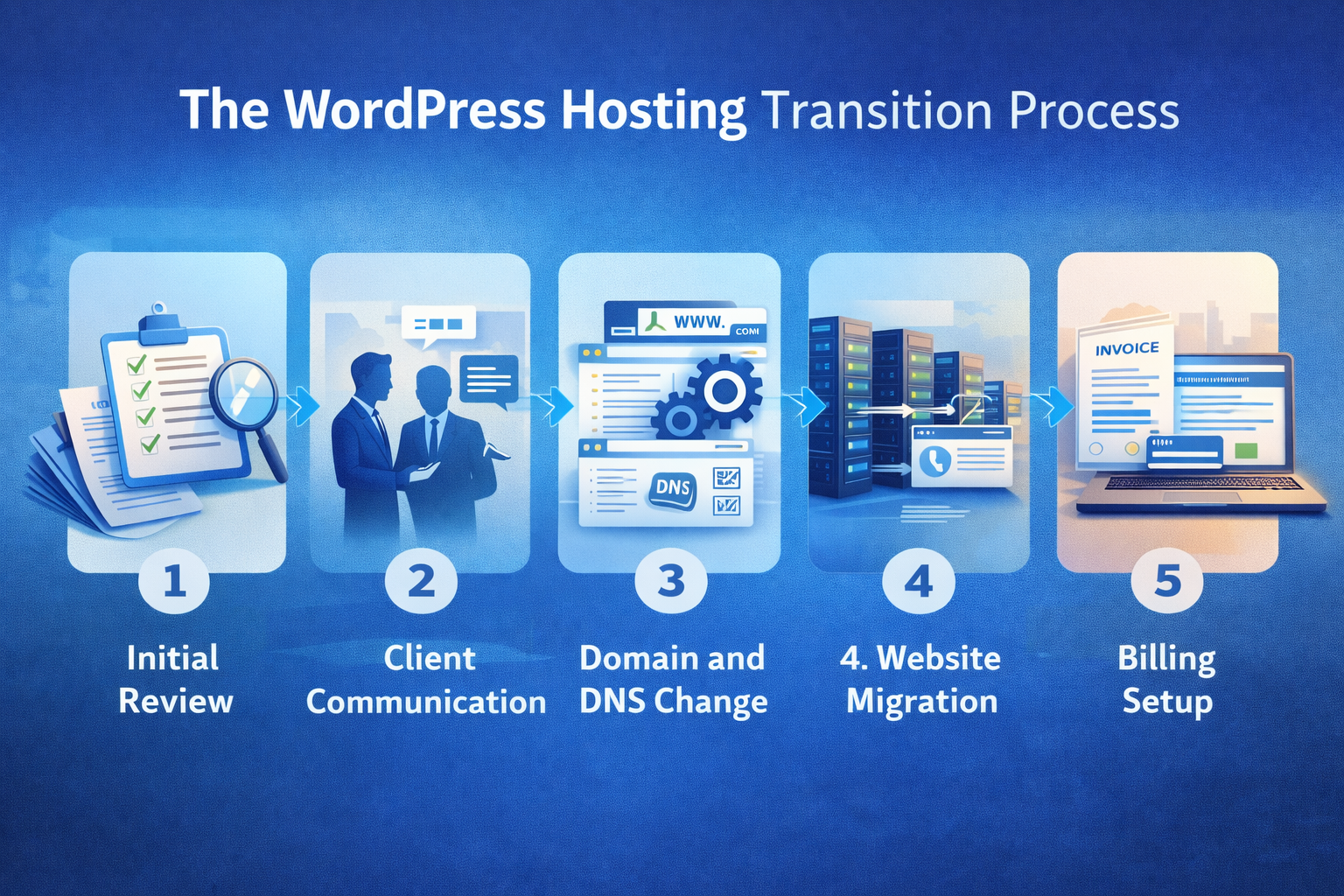
A simplified overview of the WordPress hosting acquisition and transition process from initial review through billing setup.
The Hardest Part (Client Communication)
It might surprise you to learn that the most difficult part of a transition has nothing to do with migrating websites or systems, platform differences, or any other technical challenge.
It’s actually just connecting with the new clients.
Typically, we’ll work with the seller to have them first send out a message to all clients alerting them of the upcoming change, and this time was no different. Then, I personally email each and every client individually to introduce myself, provide some basic information on the transition, and request that they fill out our intake form to confirm their contact information.
Typically we see around a 10% response rate to that initial message. Almost every single one will require an additional follow-up. The majority require several follow-ups.
Unfortunately, there’s no real way around this. It’s important that everyone understands what’s going on and that you get updated information so that you know invoices are going to the right place and who to speak with if there are ever any issues.
For a small minority, it may require months of repeated contact efforts before you actually get through.
During this process, we typically start with email but typically then progress to phone calls, contact forms, texts, and occasionally: social media outreach. We’ll do whatever it takes to connect with each client to ensure a smooth transition and maximum retention.
We have a variety of systems we use for this to track every contact point and monitor who still needs to be reached. Every attempt is logged so make sure effort isn’t duplicated. It requires a tremendous amount of persistence but is ultimately worth it.
Client Retention
Our goal throughout this process is to maximize client retention. We do everything we can to retain as close to 100% of clients as possible.
In this case, we ended with around 80% retention, which is fairly typical. That number comes from the pool of active clients in consideration for the transition and excludes some edge cases where records may have been inaccurate and clients had actually previously switched providers or shut down the site.
Of the 20% not retained, in almost all cases, one of the following was responsible:
Client retiring and closing up shop
Existing plans to transition to another provider
Businesses that were already planning to shut down
It’s extremely rare that a client won’t be retained simply because they don’t want to transition or because of something that occurred during the transition. We aim to exceed the service level of previous providers and provide as much support as needed during the transition so that clients all start out on the right foot.
This is important for sellers to understand: in most cases, client retention is driven far more by the underlying business than by the transition itself.
Things Often Overlooked by Sellers
These are some of the things that came up in this acquisition that were overlooked by the seller in the preparation phase. All of these are pretty typical for this type of acquisition and for any longstanding service business.
Incomplete Contact Information
Client contact information is often collected over the course of many years or even decades, and during that time, many different systems may have been used. While the contact information we were given was generally good, some lacked a phone number or email and what we did have was often out-of-date.
In those cases, we needed to get creative in reaching out. Checking their actual website for an email address or contact form was often the first step.
Unclear or Inaccurate Pricing
If a seller only provides one, single service with uniform pricing, it’s obviously not very difficult to keep track of pricing and provide that information to a buyer.
In this case, however, we were dealing with multiple relevant services: website hosting, email hosting, DNS hosting, and domain name registration.
Many times, these are bundled together. Other times, they are not. This adds complexity.
In this case, it was often difficult to tell which services were being billed for what price, and we also discovered later that it was inadequate to address services which were billed for overlapping periods of time.
Inconsistent Records
We also discovered a significant discrepancy between the pricing we were given and what many of the clients were actually being billed. As it turns out, a pricing increase from long before the acquisition had never been fully rolled-out, and many clients were still being billed the old rate.
Fortunately, our ARR validation method accounts for this and keeps things flexible once discovered, meaning that the final sale price reflected the actual situation.
A Few Tips on What Helps a Buyer
It’s very important to have complete, clear, and accurate documentation from the start. The following all make things go much more smoothly:
- Full list of domains
- Clear service mapping
- Consistent pricing
Lessons From This Acquisition
While this was our fourth acquisition overall, there was still plenty that we learned from it. Below are some of our biggest lessons.
Deeper Due Diligence on Client Segments
We had already signed the contract when we discovered a potentially major issue that could impact client retention. We were aware that there were a large number of websites that were franchisees from a nationwide brand. What we didn’t know until later is that there were once several times more of these, and that they had all been migrating away to a platform provided by the franchise.
If we had asked more questions about that segment, we may have learned about this ahead of time and adjusted our offer accordingly. These clients are a bit of a liability going forward since they may suddenly leave us even though we’ve paid a large sum to acquire them.
Understand External Dependencies
It’s quite important to understand any external services, requirements, or relationships that are critical to the function of the business or hosting services.
The most obvious of these are things like premium plugins for WordPress included in a large number of sites. I’ve been burned in the past by not asking enough about these and discovering later that the seller provided a suite of niche, premium plugins at no additional cost. Worse, sometimes they may be operating under a non-transferrable legacy license that no longer exists.
In this case, we knew to check for many of the obvious possibilities here. However, it’s also important to ask about any existing relationships with other website design, maintenance, or marketing agencies.
Since this company was providing all of these services internally it wasn’t too big of a problem. But we’ve had other acquisitions int he past where it turned out that a hosting company had strong relationships with other website design companies who actively serviced all of the clients. In some cases this can actually be a positive, because maintaining these relationship may mean a steady stream of new hosting clients.
But if your valuation planned for the possibility of providing add-on services like maintenance or website updates, suddenly it’s not nearly as valuable as you had believed.
Clarify Expectations Early
It’s easy to assume that if something is established in the contract, there won’t be any surprises or confusion when a particular clause is actually used. I ran into that with this acquisition.
Even if the contract clearly establishes a course of action under certain circumstances, it doesn’t mean that the other party fully thought through the ramifications of those actions and is emotionally prepared for them.
We’ve generally had good luck in this area and part of that stems from our relatively plain-language contracts and careful discussions of their function.
However, there was a situation as this acquisition progressed that I don’t think the seller was fully prepared for. What I learned is that it’s a good idea to actually walk through some theoretical scenarios once the contract is established, including both best- and worst-case scenarios so that they are prepared for them in the event that they come to fruition.
This can really help smooth things over throughout the process and help keep everyone on an even-keel. We’ve always included some basic illustrative examples as attachments to our contracts, but I think that speaking through things in a meeting is an invaluable complement to that.
Move Faster on Client Outreach
There’s a limit to how fast you can reach out to every client but and important takeaway from this acquisition is that I need to work as hard and fast as possible right away to connect with every client. This may even be more important than any actual migrations; especially if those migrations aren’t dependent on the client’s paticipation.
Some clients will need to be contacted repeatedly before you actually connect. While we managed to send out the initial email and a follow-up call to every client almost immediately, it wasn’t until later in the process when we started aggressively following-up with everyone via every channel we could find. For the seller’s sake, it’s important to me to ensure billing info and make sure that the clients pay their invoices on time and for that, we need to reach out early and often.
What I Look for When Buying
There are a handful of organizational and operational things that I specifically look for when analyzing potential acquisitions.
Legitimate businesses as clients
I’m typically looking for a book of business that includes established businesses in mature industries. Typically I want to see that they have up-to-date websites and appear very active.
If most clients are solo-preneurs with untested business models or everyone is a recent client, I’m typically not as interested and any offer I make will reflect some uncertainty.
Consistent revenue
I want to see that the seller’s business has logged consistent revenue over the course of years. Fluctuating revenue could reflect high client churn and other problems, whereas a large, recent spike could be indicative of problematic, recent price increases or other potential issues.
Transparency
When speaking with the seller in initial negotiations, it’s very important to me that they demonstrate full transparency. If they are reluctant to provide certain information, documentation sent appears incomplete, or anything they are doing is anything other than forthcoming and straightforward, I may decide to pass.
Clean structure
Ideally, I’d like to see that everything from billing to infrastructure is clean and straightforward. We want to see uniform billing systems and consistent tech stacks.
Red Flags
The following are all red flags that we watch out for.
- A seller that doesn’t do what they say they are going to do or consistently has excuses for things
- A client book made up largely of questionable businesses
- A suspiciously high number of clients that haven’t been around long
- Very high client churn
- A high percentage of businesses that appear inactive or nearing closure
- High rate of inaccurate information or inactive sites presented in documentation
- Inconsistent or disparate billing systems
- Large variety of website types or infrastructure systems and servers
Many of these may be fine on their own but still may impact the valuation.
However, any sketchiness on the part of the owner is a likely “pass” from me. If a seller appears to be hiding something, I have to assume both that it’s very bad and that I’m not going to get an accurate explanation of what’s being hidden.
Advice for Sellers
Based on this acquisition and my experience in other acquisitions, here are some top recommendations for potential sellers.
Organize everything
Get your ducks in a row. You want to be organizationally and logistically clean and organized, and you also want your documentation to be spotless. Don’t skimp on these steps.
Standardized pricing
If at all possible, standardize your pricing. This looks far more attractive to any seller and makes the transition quite a bit easier.
Just make sure you do it at least a year or two before selling. Recent price increases may scare off potential buyers.
Document services clearly
You want it to be crystal-clear to any potential buyer at a simple glance just what your recurring revenue is, from whom, and for what services. You want to make it as easy as possible for the buyer to give you an offer, and clearly-laid out financials accomplish that.
Communicate quickly
You want to make sure that you are very responsive when interacting with a potential buyer and providing anything requested in a timely fashion.
Slow responses can create unnecessary friction during the process.
Why Hosting Acquisitions Scale Well for Us
Hosting acquisitions are the core piece of our strategy and have been responsible for the majority of our growth over the last 8 years. Part of the reason why they work so well for us is because we are set up in a manner that allows us to scale effortlessly and perform the acquisitions smoothly
Front-loaded work
In our case, almost all of the work is front-loaded. We may need to migrate client websites to our servers, establish the client relationship and set up billing. But once that’s done, very little work is needed on our end.
Why?
Because we partner with data centers that handle all of the hardware and physical infrastructure, and they do a fantastic job. When you do a good job with hosting, very few client interactions are needed. In fact, I sometimes worry clients will forget about us since they never need to call us with a problem. Fortunately, we have a newsletter to make sure they remember who we are!
Once we’re set up, there’s very little ongoing load. Once we’ve completed the acquisition, we’re ready to move on to the next one.
I can devote my full attention to transitioning your clients to our systems and do it smoothly.
Key Takeaways From This Acquisition
- ~70 domains acquired
- ~80% client retention
- 1.5x ARR offer in a competitive situation
- Server takeover reduced migration complexity
- Client communication was the biggest bottleneck
If you’re considering selling your hosting business, I’d be happy to take a look and give you a realistic valuation. You can learn more here or reach out to start a conversation.


